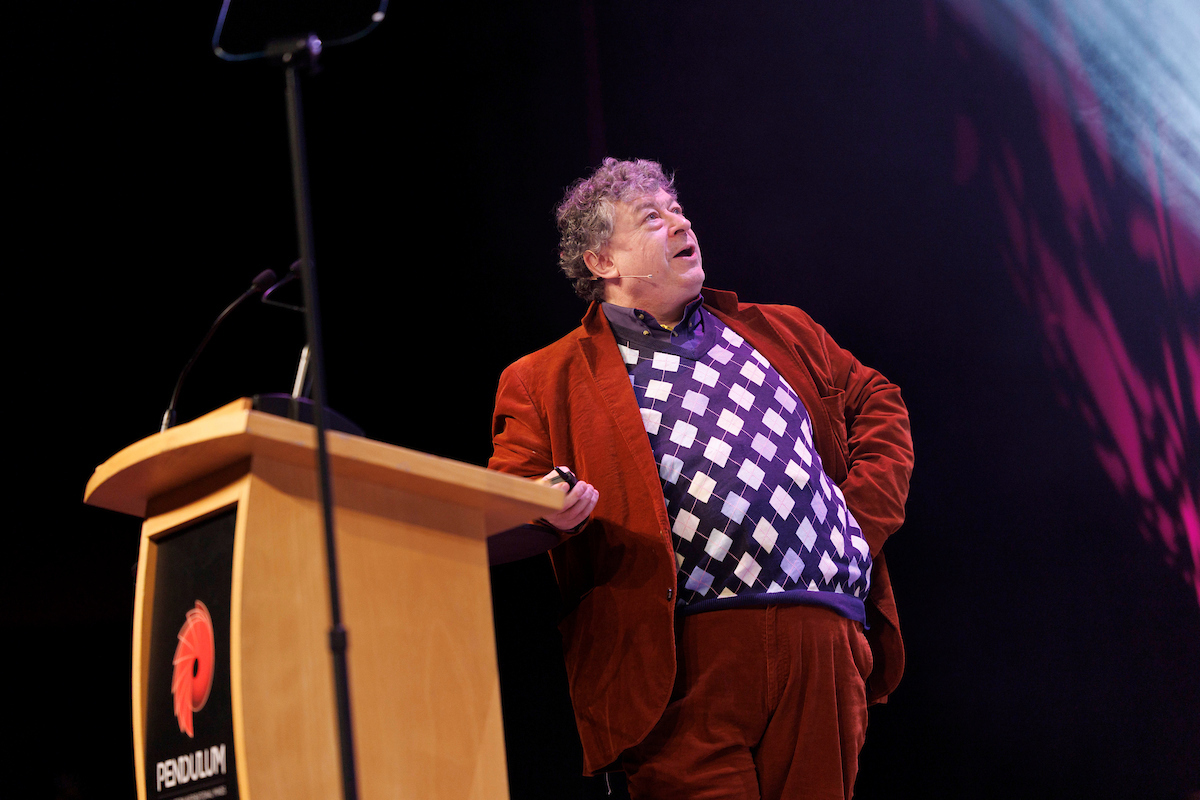
Change the Question, Change the Outcome
One of the most powerful insights from his keynote was deceptively simple:
“In school changing the question is cheating. In business it’s often inspired.”
Too often, organisations focus all their energy on refining the answer. They optimise, benchmark and iterate within the boundaries of a fixed problem. But rarely do they step back and ask whether the problem itself has been framed correctly.
For Sutherland, competitive advantage often lies in reframing. When you change the question, you escape the constraints everyone else is competing within. Innovation is not always technological. Sometimes it is perceptual.
Optimise for Emotion, Not Just Efficiency
Sutherland also challenged the room’s reliance on metrics alone. In a results driven world, we measure speed, output and scale. Yet behavioural science tells us that how something feels can matter more than how it functions.
Using a familiar example, he explained:
“What Uber changed wasn’t actually the journey itself. It was how you felt waiting for a taxi.”
The route did not radically improve. The emotional experience did. Reducing uncertainty changed the perception of the entire service.
It was a reminder to every leader in the room: customers and teams do not just respond to systems. They respond to feelings.
The Power of Surprise
Midway through his keynote, Sutherland illustrated how expectation shapes value.
🎥 Watch the clip:
Reflecting on flying from London City Airport, he explained why its simplicity makes it feel superior in a world of oversized, over commercialised terminals. The insight was grounded in neuroscience:
“And of course, to some extent there’s quite a lot of neuroscience which actually supports this, which is that we notice the things we weren’t expecting. Human perception is calibrated to pay disproportionate attention to, and therefore disproportionate appreciation of, things that are surprising..”
We do not notice what is standard. We notice what breaks the pattern.
When every competitor adds more, the one who subtracts stands out. When complexity becomes normal, simplicity becomes remarkable.
Reverse Benchmarking: Compete Where Others Don’t
Rather than copying best practice, Sutherland encouraged leaders to look for what others ignore.
“Reverse benchmarking is a way of optimizing for surprise.”
Instead of competing where everyone else is strong, he suggested finding the neglected dimension and excelling there.
“Go and do something brilliantly that your competitors don’t do at all, and then double down on it.”
In crowded markets, marginal improvement rarely creates distinction. But excelling in an unexpected area can redefine the category entirely.
Rethinking What We Measure
Towards the close of his address, Sutherland questioned our obsession with quantification:
“Very simply, we are obsessed with metrics which are becoming increasingly weird, increasingly enshrined and increasingly detached from the kind of thing that either citizens or consumers care about.”
In the pursuit of defensible decisions, organisations often prioritise what is easy to measure over what is meaningful. Yet trust, perception and emotional experience rarely fit neatly into a spreadsheet.
His message was not anti data. It was anti narrow thinking.
The Pendulum Message: See Differently
Rory Sutherland opened Pendulum Summit 2026 with a reframing, not a roadmap.
“Rather than trying to change the world, we can change how we see the world.”
And as he reminded the audience:
“When we see the world differently, we behave differently. And that then changes the world.”
In a business culture obsessed with optimisation, his message was both simple and profound. Advantage does not always come from doing more. Often, it comes from seeing what others overlook, and having the courage to question what everyone else accepts.
To hear Rory’s full talk, visit https://pendulum-360.com/